I finished reading Foundation and Empire by Isaac Asimov recently. Its a second novel published in the Foundation series. It was an enjoyable read, but not as enjoyable as the first one. Lets see if the third book strikes the right chord. Well, this post talks about the cloud of thoughts that gathered around me when I read these beautiful lines from the books:
Foundation
It is the chief characteristic of the religion of science that it works.
It is remarkable, Hardin, how the religion of science has grabbed hold. Treating the problem sociologically, it would seem that when the old Empire began to rot at the fringes, it could be considered that science, as science, had failed the outer worlds. To be reaccepted it would have to present itself in another guise—and it has done just that. It works out beautifully.Foundation and Empire
The Foundation has secrets. They have books, old books - so old that the language they are in is only known to a few of the top men. But the secrets are shrouded in ritual and religion, and none may use them.
Aren't these lines more to us than meets the eye? They compelled me to reflect upon the things that I could relate very dearly. I mean, look at the holy books presented to us by our great ancestors. The text in them are so complex that they cannot be understood in simple terms. It will take years just to study one volume of it.
Look at religion from a slightly different angle. Think of it as pure science - a branch of discipline that is so overwhelmingly powerful that our minds just out-rightly reject it, only because we fail to understand its secrets. Now what happens if the same thing is preached as religion? We accept it as a Heavenly blessing. We believe it; live it. Our ancestors were smart enough to preach science as religion, so that the people of today - who question everything with their half empty minds - follow it without doubting much. They always want us to have faith in it. Because the generation in which we all live is utterly incapable of realizing the true potential of it. Since we do not comprehend its virtues, we draw our own "home-made" interpretations out of it. Thus, either we end up following our customs and rituals because of our faith in them or we do not follow them at all! Sometimes, its mixed. I follow most of it, not all of it. You know, I am spiritual but not so religious! On the whole, as many generations passed, science became religion, and religion became faith.
I will corroborate what I just said. The Hindu calendar, just like the English calendar, has more than just days and months in it. It tells you about the future. Solar and lunar eclipses are foretold accurately well ahead of time (one, two or a few years before) with the exact time-stamp. How? There are mathematical calculations to deduce the times of their occurrences. We just don't know it yet. Another best example is horoscope - the destinies of people described based on their birthdays. There is more in Hinduism. Priests use horoscopes to calculate the compatibility between a boy and a girl if they want to marry. Ultimately its mathematical science expounded in religious ways. I am familiar with Hinduism and I am sure there are similar aspects of science in other religions also.
Asimov used science fiction as a clever device to explain religion through science in his Foundation novels. I really admire his intelligence. Way to go, Asimov!
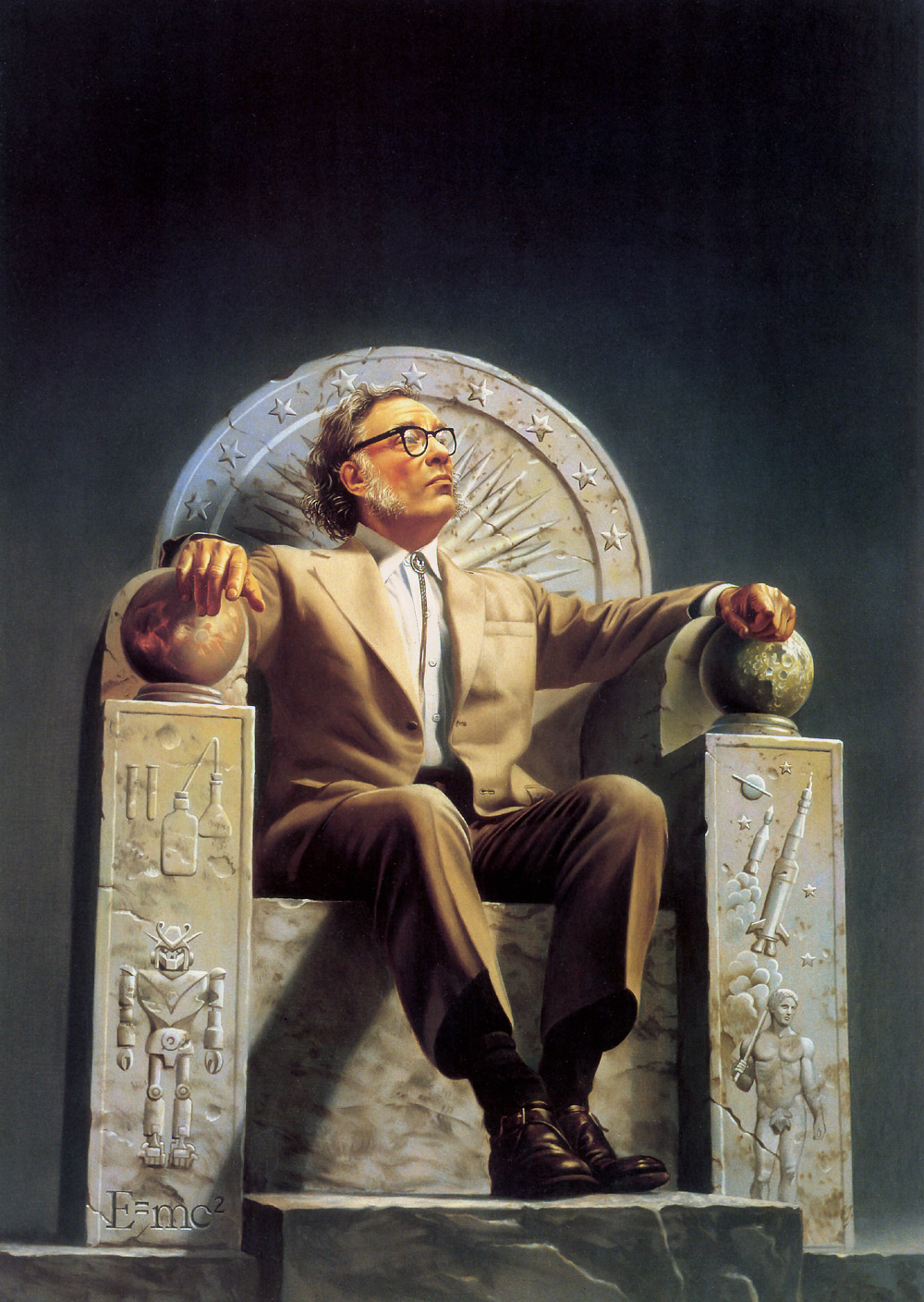 |
| The Great Isaac Asimov |


